
The Greene Team began on Monday, July 27, with a captivating lecture by a journalist who reported on the 1970s Watergate scandal and witnessed the field of journalism evolve.
Dini Diskin-Zimmerman, a broadcast journalist who has been in the field for decades, spoke to the group about her wealth of experience in a changing — yet also constant — profession.
She told about how in the past, news stations used two-inch tape to record, and they manually cut out pieces to edit them. Now, we use computers for the same task. Before, the cameras and lights were enormous, but now, they are small and compact. However, the way news is reported hasn’t changed one bit. Good reporters still strive to remain unbiased, they still state the most important things first, and they still have the constant role of updating the public on the occurrences of the world.
Zimmerman also shared another part of her interesting past with the Greene Team: she was a crucial part of increasing women’s equality in the workplace. When she started out at one of her earliest jobs, she was the only woman there, among a host of white men. They needed to hire women to support DEI, and she not only fit that requirement, but she was exceptionally good at reporting. Throughout her career, more and more women started working with her.
Later on, George Giokas delivered a presentation on the immense importance of local and school newspapers.
Giokas told the group that three quarters of those in New York City don’t have newspapers, which is problematic because students don’t get information about their communities, and young writers aren’t exposed to this vital profession.
Additionally, there has been a large decline in local newspapers throughout the country. In the past 20 years, the nation has lost approximately 3,500 newspapers. Now, over 210 counties have no local news sources at all.
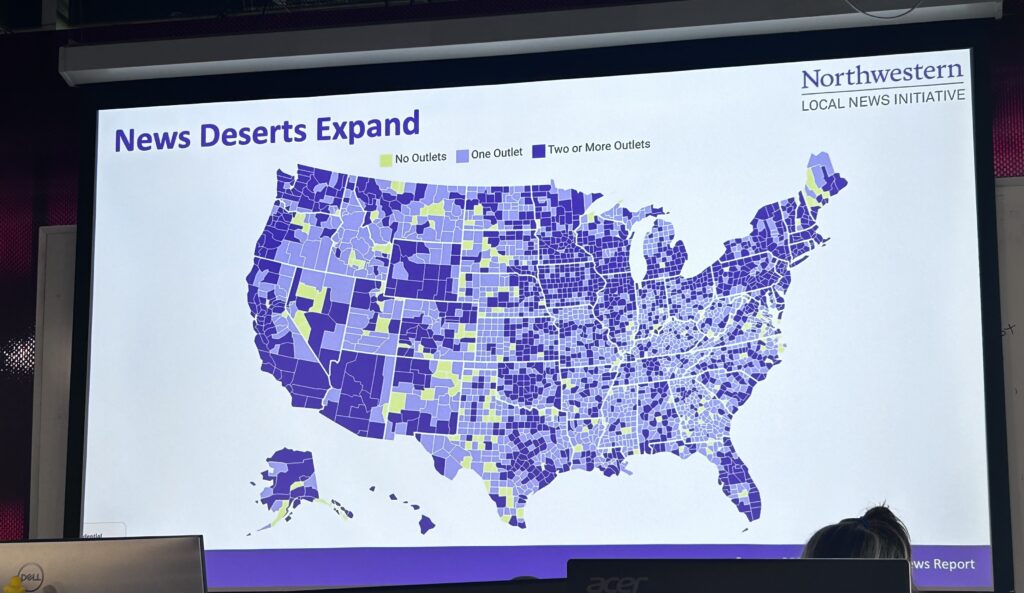
News sources are essential for public information and even participation. In fact, fewer people tend to vote when they lack newspapers. Thankfully, Long Island still has over 150 community newspapers, which serve mainly on the village level.
As Giokas put it, “You lose your identity when you lose your local newspaper.” That is why journalism is essential, and the Greene Team plans to make a contribution to it.
—Allie Harrison, Ward Melville High School