
By Allie Harrison, Ward Melville High School
and Yennifer Soriano, Hempstead High School
When one thinks of exploring the moon, they might think of a NASA control room or astronauts planting a flag in the ground, but space exploration is so much more than that.
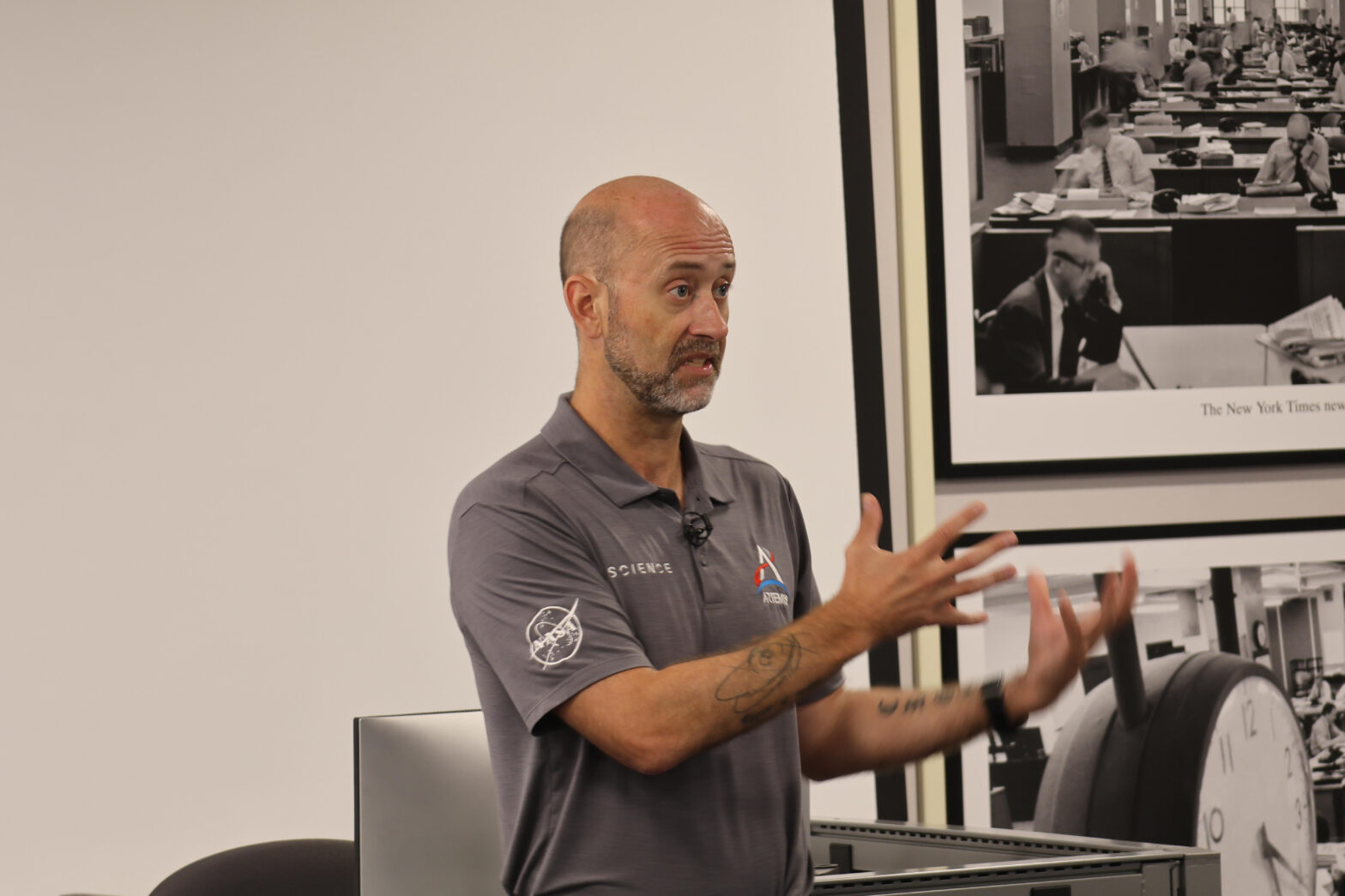
Planetary geologist and Stony Brook University professor Tim Glotch, Ph.D., spoke about his work on NASA’s new Artemis IV team on July 29, which will help us learn not only about the moon, but about Earth as well.
Artemis IV will transport astronauts to the moon for the first time in over 50 years. Ever since the Apollo missions first brought people to the lunar surface, there have been satellites and rovers but never crewed landings. However, with the mission scheduled for 2028, this is all about to change. The four astronauts will collect samples for geologists like Glotch to study. These studies can be used to learn about how the rocks on the moon — and on Earth — form.
“The selected scientists will bring a wealth of expertise to this team to ensure we are supporting crews on the Moon to achieve the missions’ science objectives,” Joel Kearns, deputy associate administrator for exploration in NASA’s Science Mission Directorate in Washington, said in an announcement. “Exploring the lunar surface and executing the U.S.’s science objectives is a major step toward sustained operations at the Moon and preparation for human exploration of Mars.”
When asked about how trips to the moon will help us learn about Earth’s history, Glotch’s answer was simple — rocks. “We have these very, very old rocks from the moon that are much older than anything we have on Earth,” he says. “And because the moon and the earth formed basically at the same time and right next to each other … the moon, those ancient moon rocks, record processes that would have happened on Earth at around the same time.”
On Earth, tectonic plate movements destroyed those similar rocks long ago. However, the moon lacks these tectonic plates, leaving the samples intact. The more lunar samples NASA can obtain from these Artemis missions, the more scientists can learn.
Glotch and other geologists are also involved in figuring out where exactly on the moon Artemis IV should land. Because of the potential for finding water, he said, they know that the landing point should be near the moon’s south pole. Craters in this area are extremely cold — some of them only about 12 degrees above absolute zero. So whenever comets or other objects bring water to these areas, it freezes and remains there. If scientists ever wanted to remain on the moon for longer periods of time, the presence of water would “make it cheaper, more affordable, and more sustainable,” according to Glotch.
When it comes to how scientists even gather all of this information initially, the answer is a process called infrared spectroscopy. This uses infrared light, which has wavelengths longer than those the human eye can see.
“It turns out you can use infrared almost like a fingerprinting technique. Every rock, every mineral, has its own infrared spectral signature,” Glotch said. “We can basically zap rocks with the red light and look at the reflected light, where we can look at the emitted infrared light from hot rocks and figure out what they’re made of.”
Just like any profession, Glotch’s work is not without its challenges. Obtaining funding for projects is a difficult and competitive process. “When we write proposals, sometimes you think you have an awesome idea, and people don’t agree with you,” he says. In that case, he would have to write another proposal to re-argue his case with the hope that the project would then get approval.
Despite this struggle, Glotch said, the Artemis missions will go on. After the 2028 operation is complete, he and his colleagues will have material to study to learn about not only outer space, but the Earth as well.
With reporting by Isabella Davis and Noah Eichenholtz