
By Kayci Guardado
Central Islip High School
Stony Brook Children’s Hospital is trading overcrowded hallways for specialized trauma bays, breaking ground on a $55 million expansion built to handle a historic surge in pediatric emergencies.
According to Stony Brook Medicine officials, the hospital, especially its emergency pediatric unit, has experienced a steady rise in patient volume, from 19,000 visits in 2014 to more than 27,000 in 2025, with a spike during flu season.
“This project has been in evolution for almost a decade now,” said Dr. Carl P Kaplan, associate professor of emergency medicine and pediatrics at Stony Brook.
Kaplan said a pediatric ER department should ideally have one room for roughly every 1,500 children seen per year. “We don’t have that now. We need that.”
Sometimes, he said, overcrowding means that doctors examine patients in the hallways, which comes with privacy concerns and medical situations that require special equipment or sterile fields. He said this is just another reason why the project is needed.
Architectural renderings show the expansion will quadruple the space of the current facility, scaling it up from 4,20-square-feet to over 17,000-square-feet. To keep in line with the aesthetic of the main children’s hospital, the theme of the new emergency department will be nautical. The waiting room will look like a sandbar, the fast track a tide pool, and the back end a deep sea. With each transition between rooms will come different kinds of artwork and sculptures.
Dr. Jessica Miller Mantell, a clinical assistant professor in pediatrics who has been with the hospital for five years, said she is excited about having innovative medical tools and their own specialized trauma base. “Those will be all new units geared towards kids,” Mantell said. “And there will also be new rooms with a faster flow to allow us to see kids quicker and easier.”
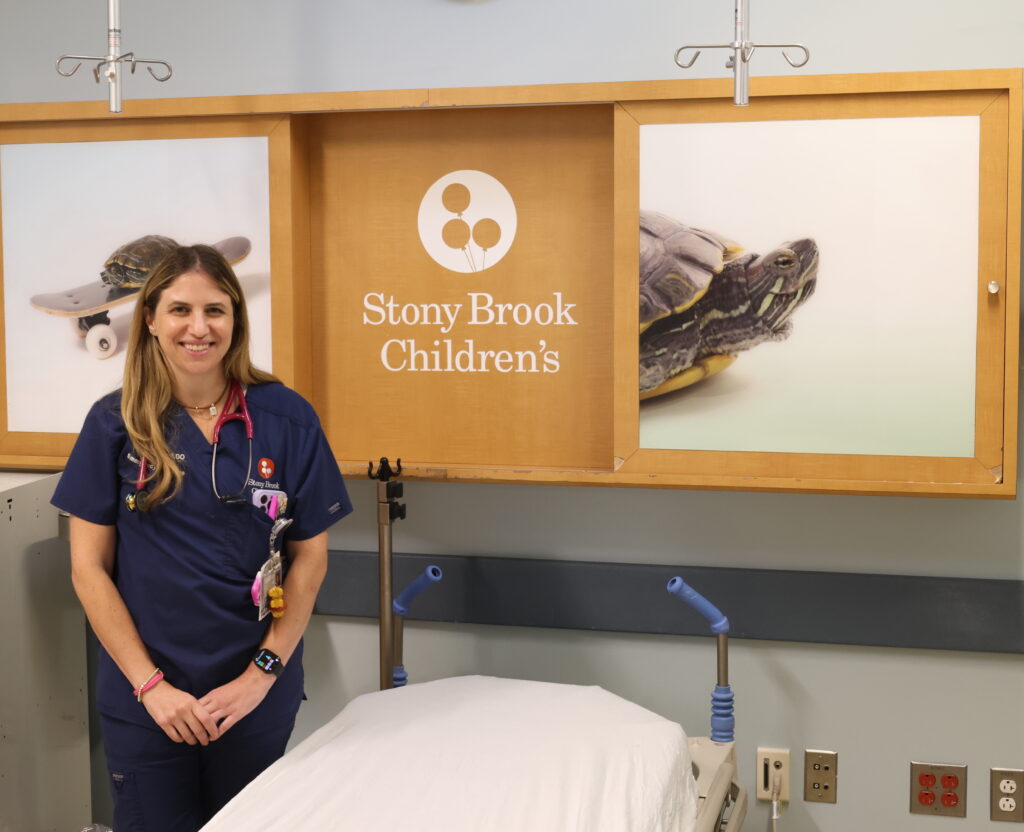
Kaplan said the motivation for the construction came from hospital leadership, including Chief Executive Officer Carol Gomes and Department of Pediatrics chair Dr. Carolyn Milana. “We started planning it, actively, approximately two years ago. And we were trying to design a unit that is child-friendly,” noted Kaplan. “That is going to be a place where we can practice state-of-the-art medicine, and where we can train the next generation of residents and fellows, to practice pediatric arts medicine.”
Hospital officials said the expansion will cost $55 million, with $21 million of that coming from nearly 200 donors.
Site work began in the fall of 2025, and the full project is scheduled to be completed by 2029. The construction is broken into two distinct phases.
”In the first phase, they’re building a brand-new building adjacent to the emergency department in a parking lot, which is currently closed for construction … Following the completion of that, we will move into that area, and then the current physical plant that we’re in now will be remodeled into a fast-track area,” Kaplan said.
He also said the construction will not impact the hospital’s daily medical workflow until the first phase is completed, at which point the team will remodel the layout.
Mantell added that the day-to-day changes have been minor. “The other day, I thought a helicopter was landing with a patient, but it turns out you can just hear the drilling.”
The two doctors agreed it’s an exciting community innovation. “As we continue to grow and expand, we’ll be able to advocate for kids more and give even better care,” Mantell said.
With reporting by Asher Squires and Myles Darby