
By May Bar
Hendrick Hudson High School
The Zuccaire Gallery is a place where students and staff alike come together to admire art in all forms on the Stony Brook campus.
Art is made to display a message in a way that words cannot fully express and to make a person feel emotions about it.
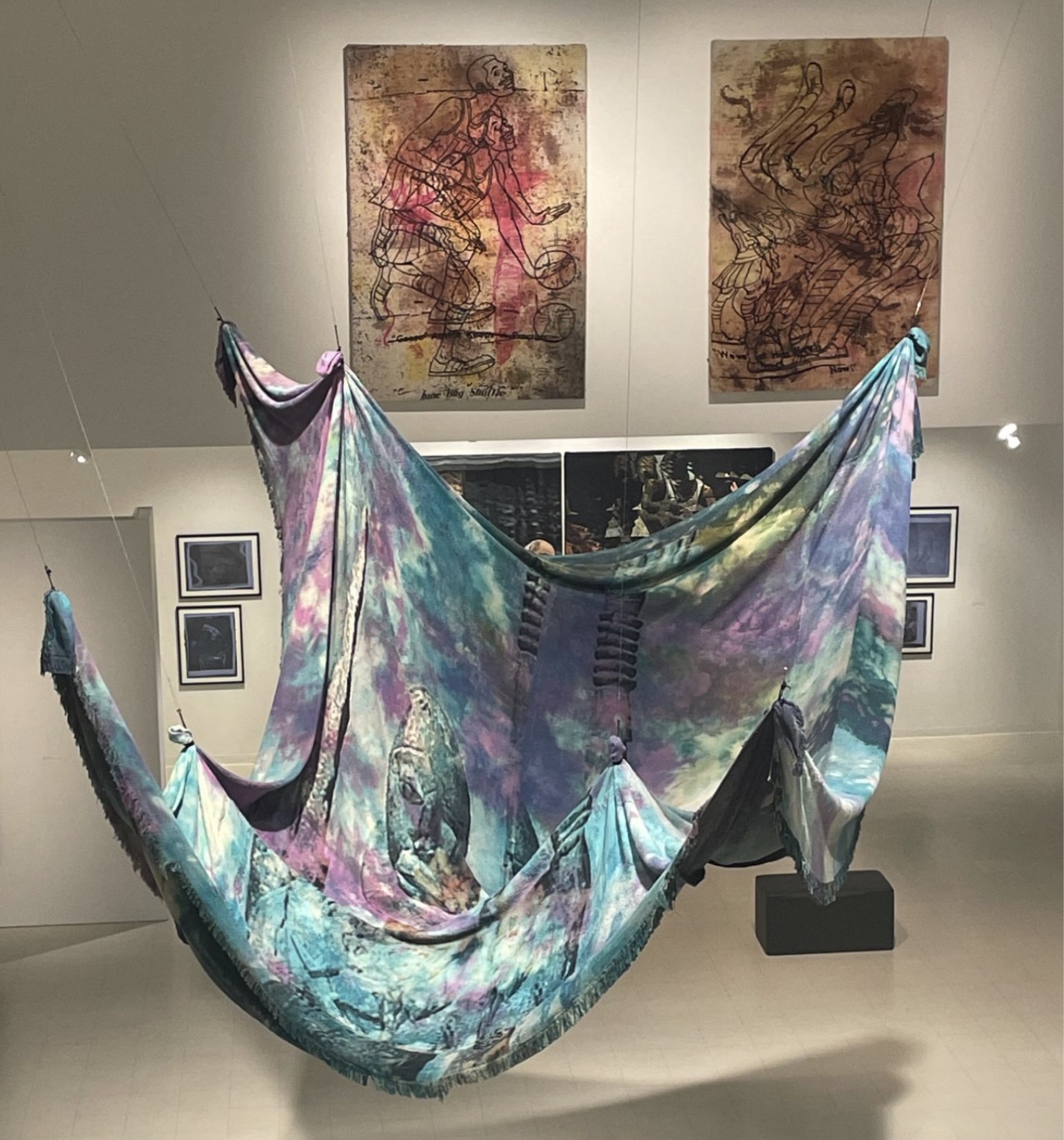
“Co-los-sus,” an art piece by Noel W Anderson in his Black Excellence exhibit, is a large, powerful and spiritual cotton tapestry that is suspended from the ceiling of the gallery. The piece shows an African sculpture called a Dogon priest. The raised arms of the Dogon represent prayer and spirituality.
In addition to the raised arms representing spirituality, in other art pieces in the gallery raised arms represent police arrests or surrender. There is a police barricade hung up on the wall of the exhibit to show restraint of the people by the police.
Following the police theme, there are also mugshots that display the stereotype of African-American men being seen criminally rather than being seen as people that are capable of more.
Two authoritative pieces show African-American figures on a throne that are intentionally raised above the others in that room to convey authority and higher status.
The placement of the art is very powerful and intentional, not only in these two tapestries but in every piece in the exhibit.
Anderson shows famous African-American people that display excellence as well as people who fall short of that standard such as O.J. Simpson.
All of the tapestries are made from cotton distressed in different ways as well as cotton balls held together in a 3D collage-like box that holds African-American culture throughout history.
Almost all of the pieces utilized cotton in some way as it is meant to represent the labor and lives of enslaved people in America. They depict history and hope in the future for the African-American community.
The art director and curator of the gallery, Karen Levitov, worked with Anderson to have his artwork displayed. The exhibition originated at the University Art Museum at SUNY-Albany.
Levitov grew up in Lincoln, Nebraska, and majored in anthropology at the University of Wisconsin-Madison, then received her master’s degree in art history. She then later did PhD work in art history at Stony Brook University. Levitov has experience working and interning in many museums such as the Madison Museum of Contemporary Art in Wisconsin, the Chazen Museum in Wisconsin, the Peggy Guggenheim Museum in Italy and the Jewish Museum in Manhattan before coming to the Zuccaire Gallery, where she has been the director and curator for 12 years.
“I always loved art — going to museums, taking art classes, learning about artists and art history — but didn’t know until my senior year of college that I wanted that to be my career,” Levitov said.
Exhibits like Anderson’s Black Excellence are examples of powerful art that will create hope and inspiration in the future generations to come, just as art did for Levitov.
With reporting by Yasmin Bardales, Angie Larrea and Gregory Valestin