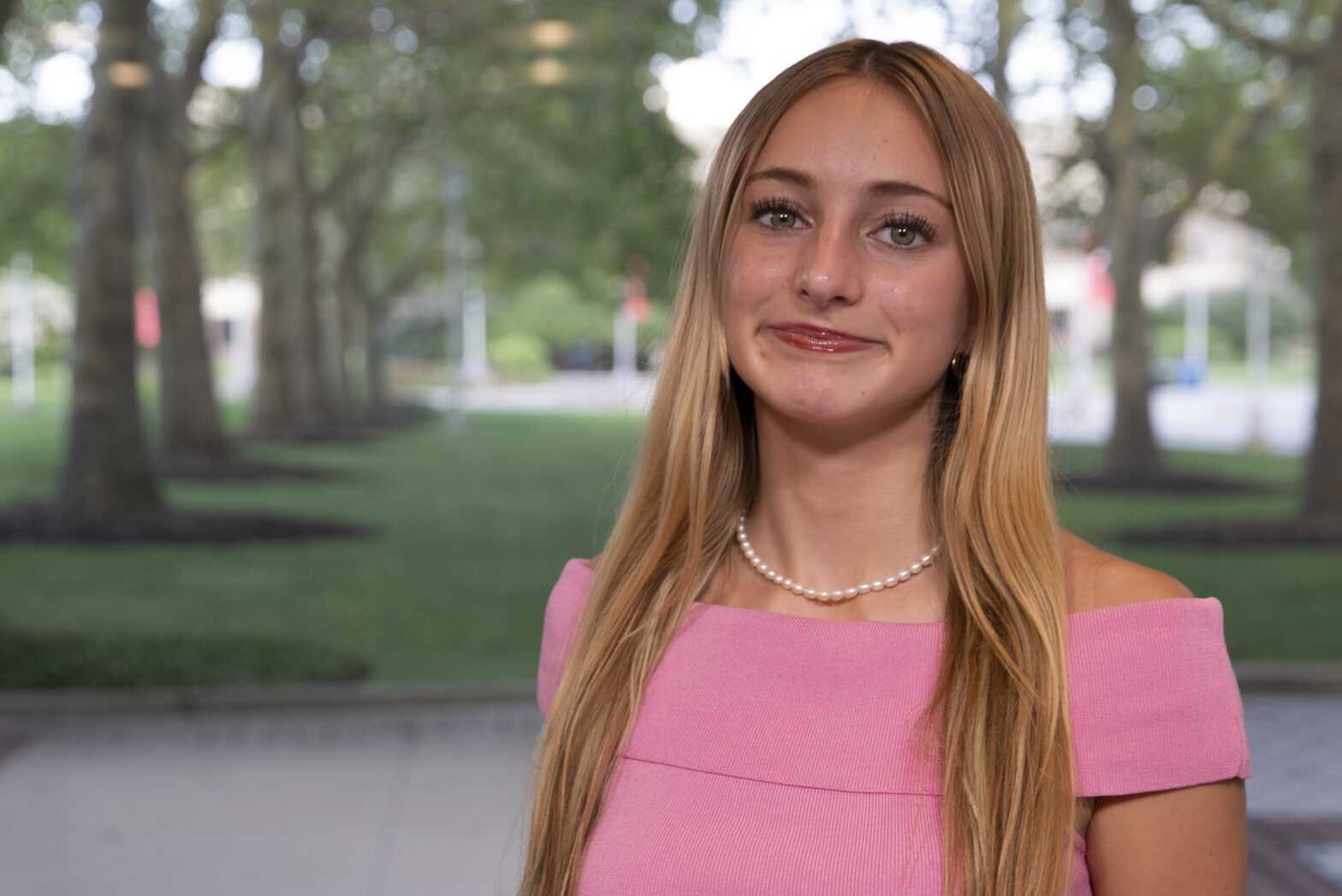
Alexandra Butuc: Finding her voice through her community

Alexandra Butuc — Northport High School

By Heily Sandoval
Northport High School

Northport High School Senior Alexandra Butuc has found her calling as a storyteller by observing and appreciating the fascinating people of her community.

Allie, who is 16, grew up in Astoria, Queens. She said the close, diverse neighborhood piqued her interest in the people and world around her. And that desire to grasp the different views of those in her hometown eventually led to her interest in journalism.

“Growing up surrounded by people from so many different cultures exposed me to a wide variety of perspectives at a young age,” Allie explained. “I believe that experience ultimately contributed to my passion for storytelling and journalism.”

This desire to learn more about journalism is what motivated her to join her high school’s newspaper club. She’s proud of one of the articles just published on NASA’s latest space travel program, “Artemis II Mission Successfully Returns to Earth.”

A passion to improve and tell people’s stories are the goals that shape her. 

“Something that motivates me to get out of bed every morning is my desire to prove to myself that I am capable of achieving my goals and making a meaningful impact on the world,” she said.

This quest to be better at what she loves doing is the primary reason she applied to the Robert W. Greene Summer Institute for High School Journalists at Stony Brook University.

“I joined the summer program in hopes to gain skills that will help me in my journalism career that I hope to pursue in my future,” she said.

During the program in July 2026, Allie found a new community – 17 other members of the Greene Team, professional mentors, and faculty and staff at Stony Brook – that gave her a window into the field she will enter.

Members of Alexandra’s family said they are intrigued by her passion for storytelling. Her sister, Victoria, said she has gained a better understanding of her older sister as she pursues her journalism dreams.

“Allie is one of the most genuine, kind-hearted people I know yet finds a way to balance that between being able to speak her mind,” Victoria said. “She’s always able to get her point across. She always stands her ground and keeps her opinions clear.”

Paula and Liviu Butuc, Alexandra’s grandparents, recalled the moments they have had together that shaped their understanding of Alexandra’s character.

“Whenever we bring up something that relates to geopolitics, we always have deep conversations and debates,” Paula said. “She always wants to hear our point of view as she shares hers. She always finds a way to stand her ground and use facts to make her point get across when there is a disagreement.”
Researchers use satellites to study what penguins eat

By Heily Sandoval
Northport High School

Do you want to know what a penguin eats?

For a hint, you could ask six researchers who followed satellite images of an Adélie penguin colony across Antarctica going back nearly forty years from outer space. The team has found new information about the penguins’ food web by tracking their guano from space through satellite images.

The six researchers ― Casey Youngflesh, Christian Che-Castaldo, Mathew R. Schwaller, Michael J. Polito, Shawn P. Serbin, and Heather J. Lynch ― peeked at the colony for their article, “Space-based monitoring of penguin diet links sea ice, food webs, and population change.”

Lynch, a quantitative ecologist at Stony Brook University’s Institute for Advanced Computational Sciences (IACS), led the team. She has also conducted other research on penguins using satellites, which in fact, can also be used to study the weather or as communication devices.

The researchers used satellite images to study the colony of Adélie penguins, and their guano, to understand what penguins digest in Antarctica.

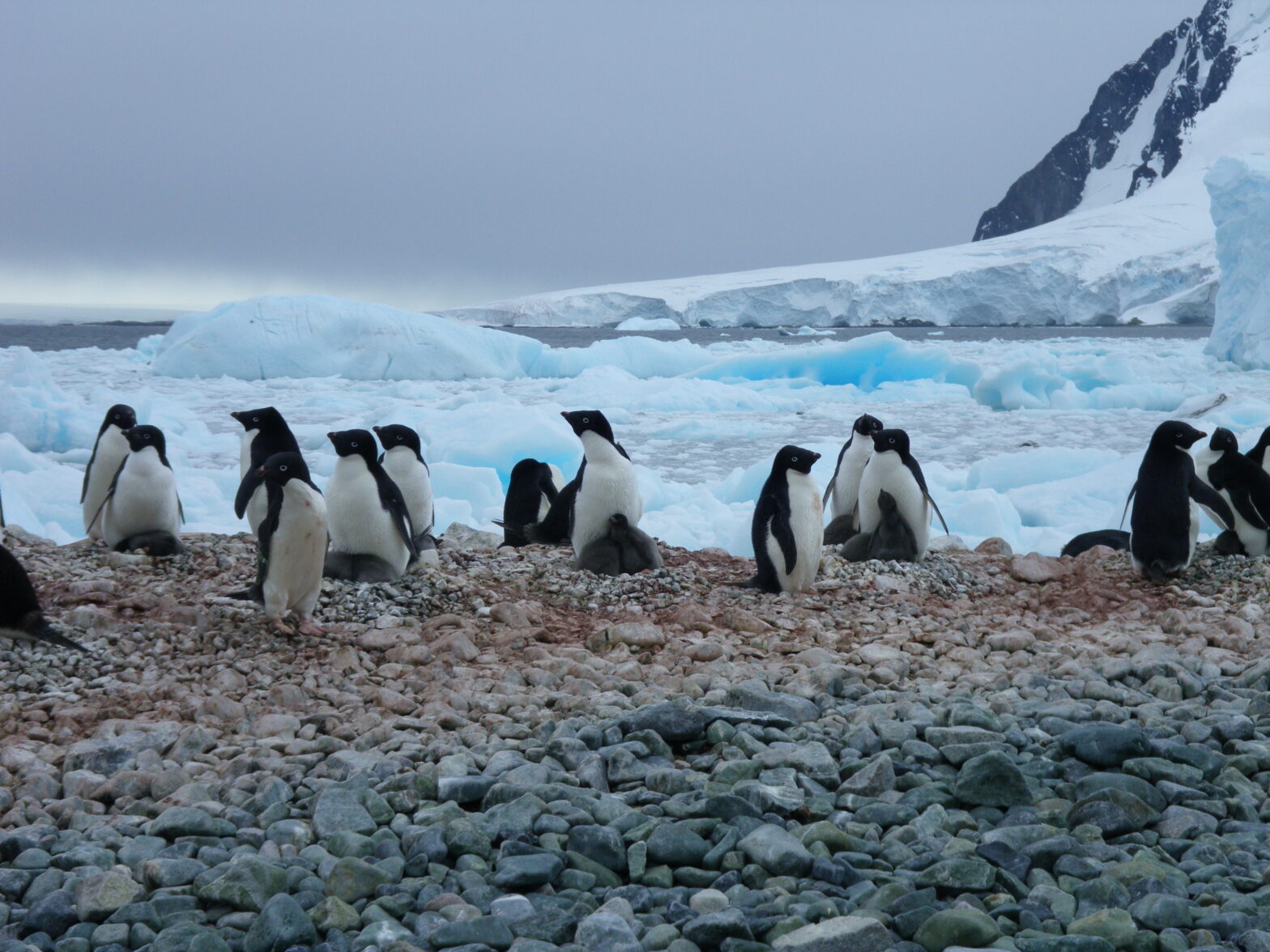
Nesting Adélie penguins on Pourquoi Pas Island in Antarctica. Courtesy of Michael Polito/University of California Santa Cruz

The team members “wanted to understand how penguins’ diet varies over space and time and whether that’s important,” Youngflesh, an assistant professor at Clemson University in South Carolina, said in a phone interview. He conducts research in ecology, the study of the natural world.

The researchers found their idea to study penguin colonies and their diets through Schwaller, who has worked for the National Aeronautics and Space Administration (NASA).

Youngflesh said that Schwaller believed researchers could discover that a satellite could help them conduct their studies of penguins and their habitats in Antarctica and could get more information with an overview from space.

“I think it was the ‘90s at some point, [Schwaller] came up with this idea that you could look at penguin colonies from space, based on the color of their guano, their poop,” Youngflesh said. “He’d been thinking about this for a long time, but it wasn’t really until more recently where we had enough subtle information that we were able to actually monitor the entire species range across Antarctica using satellites.”

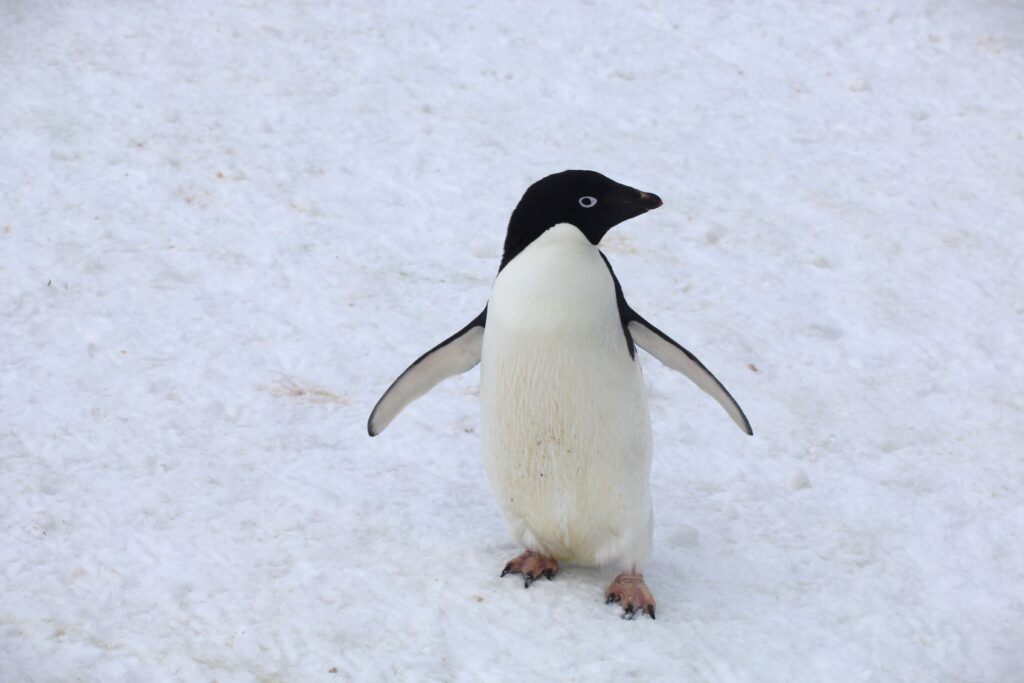
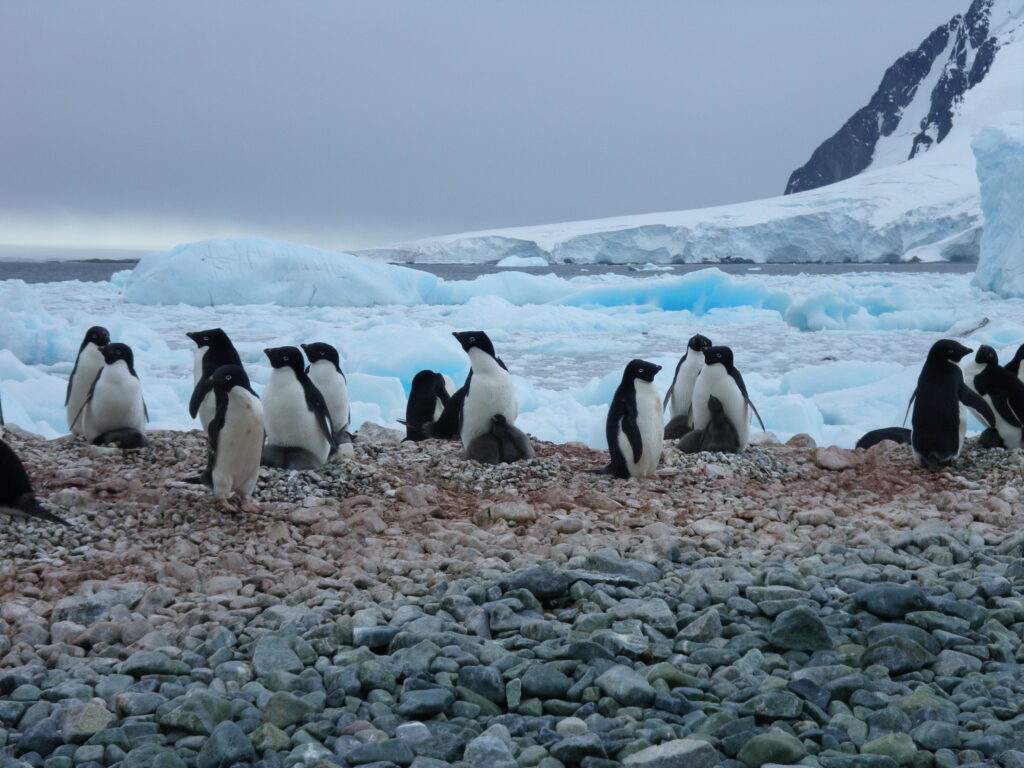
An Adélie penguin standing on snow on one of the Danger Islands in Antarctica. Courtesy of Michael Polito/University of California Santa Cruz

More than twenty years later, the team members continue to give credit to the satellite images, even though at the time, the satellites were not intended for that research.

“We started this study, raising satellite imagery, getting back to the mid-1980s,” Youngflesh said. “These satellites weren’t created to study penguins. They certainly weren’t created to look at the penguin diet, but we can actually use this in these ways that they were certainly not intended to be used … to do all sorts of cool science and understand how the natural world works.”

To complete their work, the team of researchers used the spectral signature — a way to measure color — of guano to determine what the penguins were eating. The team discovered the penguins were eating krill, which are small shrimp-like creatures, and the guano changed color depending on the krill species.

Most of the researchers watched from space, but Polito, who works for the University of California Santa Cruz, was on the ground among the penguins. He said in a phone interview that he endured chilly winds through his tent and the smell of the guano.

He and his team reached this conclusion in the article: “Rapid environmental change is reshaping Antarctic ecosystems through shifts in temperature and sea ice dynamics, with implications for species such as the iconic Adélie penguin.”

Alexandra Butuc, Christopher Cabrera, and Haru Dukanac contributed to this story.

My surprisingly good first day at Greene

To say that I was nervous to attend The Robert W. Greene Summer Insititute would be an understatement. I remember just a few hours ago, in my mom’s Honda car, heading to Stony Brook; I felt like my heart was going to beat its way out of my chest. I had barely thought about it for months, that I was going to be focusing on my future career for a whole week, and continue writing articles or making blogs. And now, I’m comfortable in my bed at my dorm, feeling more confident than ever. On the first day of this Institute, after we got ourselves situated in our dorms, we headed off to attend a meeting about housing; and what should be expected of all of us during this week. I listened closely to what the teachers were saying, and throughout the entire week of exciting work I’m going to do. I’m mostly excited about the Ducks game on Tuesday evening! I have never been to a Ducks game before, but I had always heard about it. The thought of attending my first ever baseball game, even if it’s going to be pouring that day, excites me. After the meeting, we headed off to the campus library, where we entered a room with many computers. It was easy to navigate through the process of learning how to write a blog on a platform like this, especially since the teachers were showing us step by step how to. After the short lesson on how to do our assignment, the Stony Brook campus’ bell struck — it was already 5 pm. After the bell rang, we headed off to the cafeteria. The cafeteria was huge, with many food options. After waiting in a line for just a few minutes, I finally got to the many options of food. After I picked the food I wanted, I sat down near my dorm mate, and I ate pulled pork, half of a cheeseburger, and broccoli; and I drank it all down with a cup of Coca-Cola with ice. The meal was good, better than I expected. But what I really enjoyed about our time in the cafeteria, was getting to know the other girls, and my dorm mate, who all shared where they were from. And now, I’m lying in my comfortable bed, writing this blog after taking a relaxing shower. I couldn’t have asked for a more calming day, and hopefully tomorrow will be as calming, or exciting, as today was.

  • Heily Sandoval, Northport High School

My easygoing second day of Greene Week

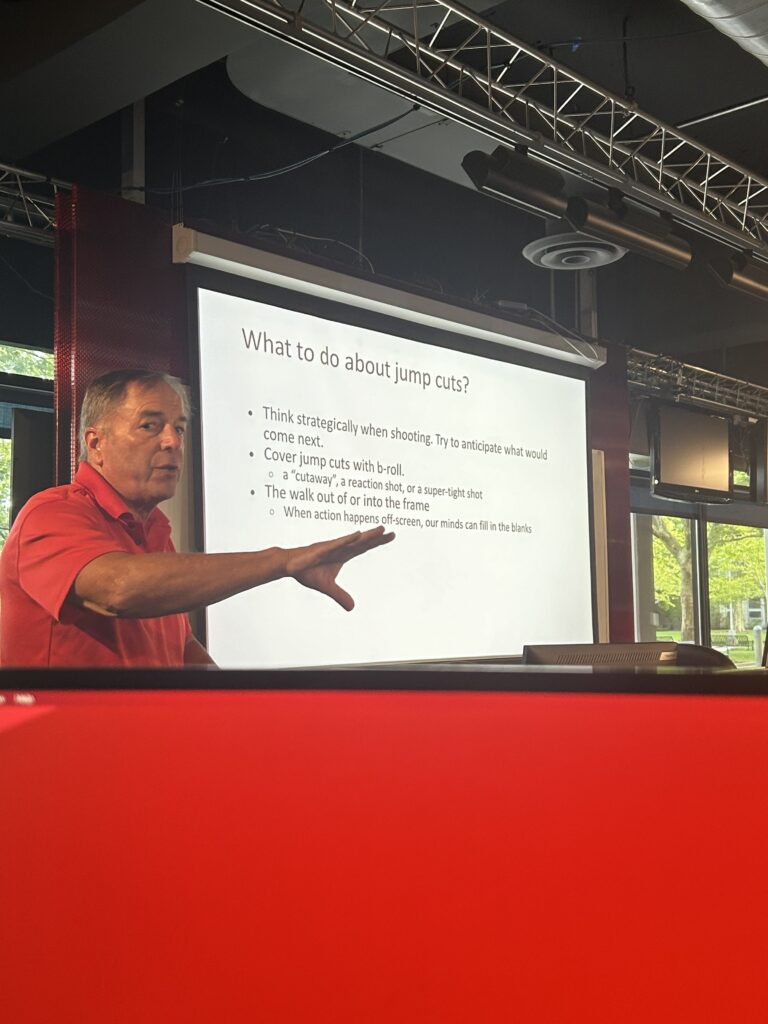
My second day at this institute was a lot more thrilling than my first, since the only hard part about my day was waking up at around 6:30 a.m., to go get breakfast at 8 a.m. Other than that, we stayed in the Stony Brook newsroom, where we had many guest speakers who were eager to share their history and experience with us.

I’ve learned many interesting things throughout these lessons, like how to operate a high functioning camera, how to make a good lede, listening to other’s stories, and some podcast/interview ideas to do during this week. My breakfast, lunch, and dinner were also pretty good; I ate up scrambled eggs with hash browns in the morning, mashed potatoes with fries and chicken, and finally some fries with a turkey sandwich. My second day at this institute was pretty interesting, since I got to see what the rest of my week would look like, or be similar to; and I got to learn a lot of valuable things I’ll need to use for my journalism career in the future.

— Heily Sandoval, Northport High School

Ending the third day with a Ducks game

Tuesday, July 28th — the third day of the Greene Institute. I can confidently say that this has been my favorite day so far. We started off the lesson with a special guest, Maya Brown. Maya Brown is a new journalist who dedicated 10 years of her life to get to her goals, sharing her stories. And afterwards, even if we were focusing on our stressful, and hard to organize work in the beginning — the same work due this Friday — we ended the stressful work just by getting on the Stony Brook bus.

On the bus, we headed to the Newsday headquarters in Melville, New York. The ride was about forty minutes. And it was like a whole other world when we stepped inside. There were many televisions, broadcasting the different work that the journalists working at Newsday accomplish. I learned that Newsday is the most successful, local news in Long Island. And after hearing advice, thoughts, and opinions of each different workers there, we headed to different places inside Newsday. There was a podcast room, generated by Chat GPT; and the room even had the infamous Joe Mele, a TikTok star. Afterwards, we headed to where reporters, and weather forecasters, sit or stand. It felt like a lucid dream just standing in the room. After the Newsday headquarters, we packed up our stuff after taking a group photo, and headed off to Central Islip for the Ducks game.

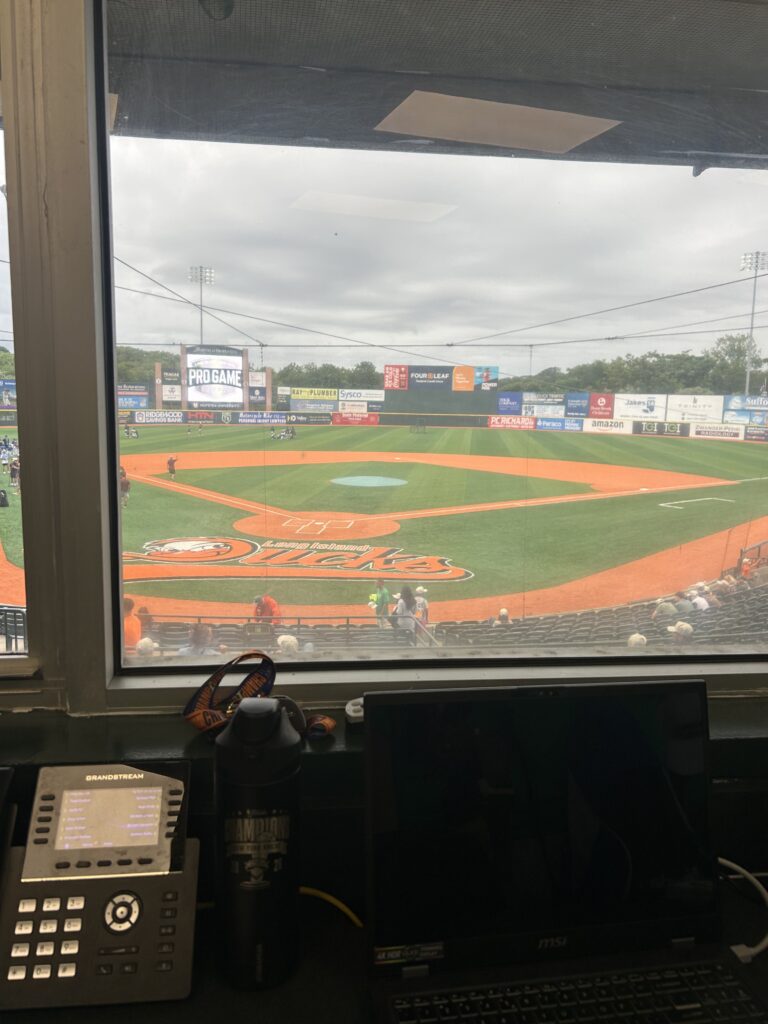
After making it to the stadium, my other teammates and I walked around inside the stadium for a little while. We we grabbed our delicious food, and watched the game. I ate a hotdog, popcorn, and an iced Coca Cola. The best thing wasn’t that the Ducks were winning this game, but it was that I spent it with my teammates.

— Heily Sandoval, Northport High School